
Search
-
 June 23, 2023By Tonny Onyuolo, OSV News
NAIROBI, Kenya (OSV News) -- Religious leaders, including Catholic bishops, have continued to donate relief items to hunger-stricken families in East African countries to help them overcome the effects of drought, the worst in 40 years, followed by five consecutive failed rainy seasons.
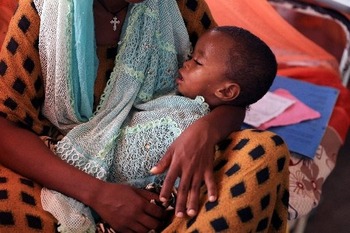
The World Health Organization warned that the region is experiencing one of the worst hunger crises of the last 70 years.
The United Nations estimated that based on 2022 statistics, the most recent available, more than 37 million people in East Africa are facing hunger, with 7 million children under age 5 acutely malnourished.
According to 2022 figures from the African Development Bank, of the 828 million people suffering from hunger globally, 278 million live in Africa. That figure could rise to 310 million by 2030, warns the U.N.'s Food and Agriculture Organization.
The East African countries facing the greatest hunger include Kenya, Somalia, Uganda, South Sudan, Tanzania, Ethiopia and Burundi.
In Kenya, which is currently home to more than 53 million people, over 2.9 million people in the northern part of the country face severe food insecurity, according to the U.N.'s Office for the Coordination of Humanitarian Affairs. However, European Commission figures showed that the number reached 5.4 million between March and June alone.
The Catholic Church led by the Archdiocese of Nyeri in central Kenya launched a "Hope 4 You" initiative in 2022 to raise funds and purchase relief items to help residents of the drought-hit regions, especially in northern Kenya.
Archbishop Anthony Muheria of Nyeri said that so far, the church had raised more than $320,000 and used part of the money to buy basic items such as food, cooking oil, soap, and water for those facing hunger in various parts of the country.
"We have decided as a church to stand with those suffering from hunger and cannot put food on the table," Archbishop Muheria told OSV News, revealing that more than 40,000 families have already benefited from the Catholic Church's initiative.
"We urge people who have been blessed with 'something' to think about others, and help those that are less privileged," he said, adding that "it's sad to hear how people are suffering and going to bed without food."
"I want to urge everyone to continue donating food and money to help families suffering from hunger. Any little contribution will help save a life," Archbishop Muheria said.
In South Sudan, more than 7.8 million people out of 10.75 million are projected to fall short of their minimum food needs in 2023 as the country enters its fifth year of severe food insecurity, the International Rescue Committee said.
Church leaders said the decade of civil war uprooted hundreds of thousands of families and forced them into refugee camps as homes and crops were destroyed, causing hunger and suffering.
Bishop Alex Lodiong Sakor Eyobo of Yei, South Sudan, said the people staying in refugee camps and those currently fleeing their homes -- due to the civil war that started in 2013 -- desperately needed food. Even if the capital, Juba, is free from fighting, attacks are still happening across the country.
Bishop Eyobo said the Catholic Church, partnering with other nongovernmental organizations, has been distributing maize, beans, salt, cooking oil, water, flour and other relief items to vulnerable communities, especially those living in various camps in the country.
"We are reaching out to those people facing hunger due to the ongoing civil war and helping them with food and water to stay alive," he told OSV News, appealing to help the people of South Sudan with food and other relief items.
"The war in the country has forced people to run away from their homes with nothing to eat, as sometimes militant rebels destroy food storage facilities," he said.
Additionally, thousands of people are crossing the border of South Sudan from neighboring Sudan in the north, where civil war broke out on April 15. This puts South Sudan, the youngest African country, at even more food insecurity risk.
Also, in Somalia, home to 17.7 million people, 6.5 million people were facing acute food insecurity between April and June 2023, according to the U.N. World Food Program report.
In neighboring Ethiopia, the situation is even more dire. The United Nations estimates that 20 million people are currently experiencing food insecurity, and the number could rise steadily in 2023 if aid is not immediately scaled up, because seasonal rains are poor.
Pope Francis asked the international community to intervene and help the people in East Africa.
"The populations of this region, who already live in very precarious conditions, now find themselves in mortal danger due to drought," Pope Francis said Aug. 14, 2022, during his Sunday Angelus address. "I hope that international solidarity can respond effectively to this emergency."
The pope's call prompted Catholic charities to swing into action and help avert large-scale starvation in Somalia and Ethiopia by providing food, water and other basic necessities.
Trócaire, the overseas development agency of the Catholic Church in Ireland, is among the Catholic agencies helping victims of hunger in East Africa. The charity provides health care, clean water, food, nutritional screening and treatment for malnourished children. It also trains community health workers in Somalia to reach the most vulnerable in Internally Displaced Persons camps and communities.
"The situation in Somalia is dire; hunger is claiming more lives daily, and children are the most affected,” said Paul Haley, director of Trócaire Somalia, thanking everyone who has so far contributed to the cause of saving lives in Somalia.
"We are helping where we can, but I want to call for immediate action to be taken to save more lives. The international community and governments should respond to the suffering of the people of Somalia and save more lives," he said.
"We will use every shilling and every euro we receive from donors to save the lives of vulnerable people, including small children facing starvation," he added.