
Search
-
 March 11, 2026By Silvio Cuéllar, OSV NewsMore than 25 years ago, I was working in the diocesan Office of Life and Family when I received a phone call. A sidewalk counselor was speaking to a young pregnant woman who was considering aborting her baby. Because the person did not speak Spanish, he handed her the phone so I could speak with her.
That is how I was able to talk with Marta and offer her help and support.
For more than a decade, my wife and I accompanied this young mother. The baby Rosa was born and became the joy of her life. Eventually, Marta moved to another state and we lost contact, but it fills me with joy to think that somewhere there is a woman continuing her life alongside her daughter, who became the greatest source of her hope.
We are now in the season of Lent, a time that invites us to pause in our routines and focus on three spiritual pillars: prayer, sacrifice and charity.
Perhaps you do not yet have a consistent habit of prayer. This season can be an opportunity to give a little more space to God in your daily life.
For example, when you wake up in the morning you can thank God for the gift of a new day. On your way to work, you might say a short prayer or listen to religious music that lifts your soul and fills you with peace, so that you can be a light to others in your workplace and in your community.
I often take my daughter to school, and when we reach the halfway point of the drive, we always begin a prayer. We pray for people in our circle of friends and family who need our prayers, as well as for our deceased loved ones.
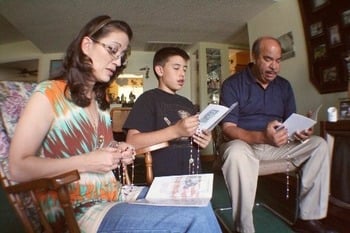
The holy Rosary is also a very powerful spiritual tool. If you are not used to praying it, you can begin with just one decade or set aside one evening a week to pray the Rosary as a family.
The Irish priest Father Patrick Peyton, who has been declared "venerable" on the path toward sainthood, promoted family Rosary prayer for decades and is remembered for a well-known phrase: "The family that prays together stays together."
Lent also invites us to practice sacrifice. Traditionally, Catholics abstain from eating meat on Fridays, but for some people that may not represent much of a sacrifice. There are always other ways to practice fasting.
For example, we could give up buying a daily coffee and save that money to help those who are most in need. One concrete suggestion is to divide our offerings into three parts: one for our parish, one for the diocesan appeal, and one to help the poorest people in the world.
The bishops of the United States have a humanitarian agency called Catholic Relief Services, through which the Church helps the poorest people in some of the most remote and vulnerable places on the planet.
Last year, the current administration eliminated a large portion of international humanitarian aid programs, and other countries also reduced their contributions. As a result, many communities around the world are facing hunger, poverty and a greater risk of disease.
In the Gospel of Matthew, chapter 25, Our Lord Jesus Christ reminds us that on the day of judgment we will be evaluated by how we treated the smallest and most vulnerable among us.
Generosity should be part of our Catholic culture of stewardship. This means regularly setting aside a portion of our income to share our blessings with those who are most in need. But in order to be generous, we must first organize our finances, our budget and our spending so that we can intentionally reserve a portion for charity.
I like to think of a simple formula: allocating about 70% of our income for our expenses, 20% for savings, and 10% to help those in need, whether through our parish, our diocese or global charitable works such as CRS.
When we organize our expenses well and try to live simply -- without the constant pressure to buy the newest or latest things -- we discover that there is plenty of room to live with more prayer, a little sacrifice and abundant generosity in our charity.
Let us always remember that there is more joy in giving than in receiving.
It brings me great joy to remember the young Marta and her daughter Rosita, whom my wife and I were able to help for many years. Perhaps we cannot change the whole world, but we can make a difference, one life at a time.
"For I was hungry and you gave me food, I was thirsty and you gave me drink, I was a stranger and you welcomed me" (Mt 25:35).