-
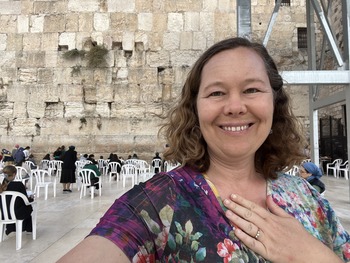 December 12, 2023
By Kristin Van Tilborg, Director of Adult Faith Formation at St. Francis de Sales Parish in Tucson
“This site is closed. You need to go back to your hotel and stay there,” the Israeli soldier said to us with great intensity.
It was October 7, 2023. Hamas had just invaded Israel, and my mom, aunt, and I were on pilgrimage, driving through the West Bank in our rental car. In a tense journey past checkpoints, closed roads, and protests, we made it to Old City Jerusalem, our home for the next nine days. We lugged our suitcases through empty streets up to Jaffa Gate and breathed a sigh of relief once we’d reached our Airbnb.
“Is there a shelter-in-place order?” my mom texted the owner.
“No, there is no bomb shelter. You’ll just have to make do,” came the ominous reply.
The next morning, all the shops, restaurants, and tourist sites were closed. Jerusalem was eerily quiet.
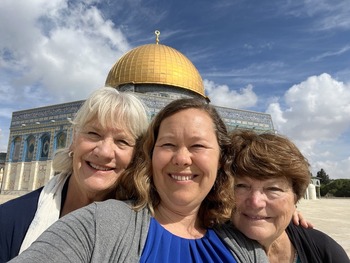 But the churches were open. The Church of the Holy Sepulchre, marking the place of Jesus’s crucifixion and resurrection, was a five-minute walk from our apartment, and it became our home away from home. With no tourists, we often had the place to ourselves, and it was glorious. We went to Mass there often. The most memorable time was inside the tiny chapel built over the empty tomb of Jesus, which holds barely a dozen people. It was an Arabic Mass for the local Palestinian Christians. “Salaam!” we greeted them. “Peace!” they replied. All the Christians in the Old City, Western and Palestinian alike, hoped and prayed continually for peace.
 As soon as the local grocery store opened, we all went to buy supplies. The store was packed with people buying canned food, bottled water and toilet paper – Arabs and Westerners, Jews, Christians, and Muslims. “Look around!” one man implored us. “We live side by side here! We are neighbors! When you go home, tell people it’s not like what they see on the news.”
Later, when the sirens went off, we hunkered down in a windowless room in our apartment and listened to the bombs explode around us. I was strangely glad for the experience. I felt a sense of solidarity with the people who lived here.
“I can’t believe Hamas is bombing their own people!” said one artist in the Jewish Quarter. Old City Jerusalem is majority Muslim and Arab. “We must not use this attack as an excuse to hate the Arabs,” said another Jewish man.
One day when we went to the Temple Mount, the Israeli soldier who was questioning us burst into tears when we pulled out our American passports. “If it wasn’t for you, we wouldn’t be here! Thank you for protecting us!”
“Thank you for protecting us!” we replied. We all cried together.
The Muslim Quarter was an unhappy place. Everyone was on strike and the streets were nearly empty.
To walk the Via Dolorosa, which goes through the Muslim Quarter, we latched on to the one tour group we could find, an Orthodox group from Romania. Before the trip, I had prayed and asked God if he could show me the place where St. Stephen was martyred. The first place the tour showed us was the Orthodox Church of St. Stephen. The priest unlocked a special room for us, and we kissed the ground where Stephen was martyred. I thanked God profusely.
Later, as we walked through the Muslim Quarter, the priest asked us who we were. “You are Catholics, we are Orthodox. We are like brothers! You come with us,” he instructed. He used a paintbrush to make the sign of the cross on our hands and face with oil and announced to the group, “We are protecting the Americans now! USA! USA!” So much for anonymity! But the love we felt from so many people was amazing.
We knew many of the Palestinians supported Hamas, but we still empathized with their suffering. We saw a young Palestinian man cry when he couldn’t enter the Old City to see his family, and saw another man taken away by soldiers while his young son ran after him shouting “Baba! Baba!” One morning we showed up at our usual cafe and the owner’s face was stricken. He couldn’t speak. We knew without asking that someone he loved had died.
While we sipped our coffee in hushed silence, an alert came from the U.S. Embassy. They had an evacuation ship for us leaving for Cyprus the next morning. There was one place I was determined to see first: the City of David, the archeological site containing the oldest part of Jerusalem. There were three sights there I had prayed to see: the ruins of King David’s palace, the Gihon Spring where Solomon was anointed king, and the Pool of Siloam where Jesus healed the blind man. These sites were in a hostile neighborhood. The first time we had tried to enter, a group of young men jeered at us until we left.
This time, the City of David seemed completely abandoned. I walked down a flight of stairs and there it was: the ruins of King David’s palace. I praised and thanked God. The Gihon Spring, though, was locked up tight. We wandered down into the Kidron Valley, dusty and lined with ancient tombs. It was also filled with decrepit apartment buildings and littered with garbage. We realized that this was the same neighborhood where we had heard firecrackers go off after Friday prayer celebrating Hamas. “We need to get out of here now,” my mom said.
Just then a young Muslim man walked up to us. “Where are you from?”
“America,” I murmured.
His face lit up. “I used to live in Minnesota! Do you want to see the Gihon Spring? We live next door to it!”
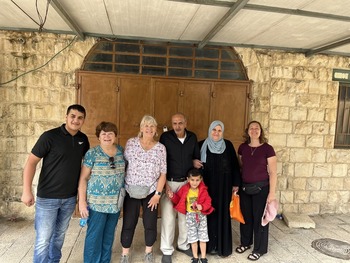
He showed us a secret back door with a hole cut in it so we could poke our heads in and hear the spring. He invited us home, where Grandma Fatima served us mint tea, and Grandpa Abe gave us one of the best Bible studies I’ve ever heard, telling us the history of his neighborhood from Abraham to Jesus. After tea, we all piled into the family’s van. They drove us to see the pool of Siloam on our way back to Jaffa Gate.
During the trip, I prayed Psalm 91 continually and felt God’s protection. “A thousand may fall at your side, ten thousand at your right hand, but it will not come near you.” But the main thing I heard in prayer was an instruction: Love everyone.
May we follow the example of Jesus and so many people in Israel today, the people who don’t make the news. May we love everyone and pray for peace.