-
 November 25, 2025
Submitted by Catholic Medical Association Tucson Guild
“Behold the inheritance of the Lord are children: the reward, the fruit of the womb.” Ps 126
The above psalm is commonly rendered in an abridged form as, “children are a gift from God”. This reality is particularly poignant to me as I write these words, anticipating the imminent arrival of a new child. When I became a father, I was made acutely aware of this fact and captivated by the truth of it. Looking into the eyes of a newborn child, one cannot help but be overwhelmed by the dual realization that there is scarcely anything in this world that they could love more and that there is nothing they could have ever done to deserve it. Children are a gift from the Lord, completely unmerited; they are a grace. Herein lies the fundamental misunderstanding of those who condone the practice of in-vitro fertilization (IVF). No one deserves the Lord’s gifts.
Like many errors in our current culture, the support of IVF stems from a flawed empathy and considering the reality communicated above it is easy to see why. Who would not want those that they love to experience this gift? This is especially relevant in a culture increasingly afflicted by the cross of infertility. Unfortunately, this sentiment quickly devolves into assent, at least tacitly, of the proposition that anyone who wants a child deserves a child. The paradigm shifting from the acknowledgement of children as a gift, to children as a right. If children are something that we have a right to, then we are justified in using whatever means available to us, in order to obtain one. Lamentably, it would seem that the majority of Catholics have succumbed to this faulty line of reasoning.
According to a Pew Research study done in 2013, only 13% of US Catholics believed that IVF was morally wrong.1 This sentiment was confirmed by Pew Research earlier this year, albeit with a smaller sample size, which demonstrated 83% of respondents claiming that the Church should permit the practice of IVF.2 The numbers do not improve much when dividing respondents into weekly and non-weekly mass goers, with 77% of weekly mass attendants still in support of IVF (88% for non-weekly). These numbers are in spite of multiple magisterial statements on the matter (i.e. Donum vitae, Evangelium vitae, Dignitas personae), which enumerate myriad reasons for the Church’s condemnation of the practice. Not the least of which, is that IVF far exceeds abortion in the destruction of human life. To increase the odds of success, more eggs are typically fertilized than the number of children the couple intends to have; in some cases, multiple embryos are implanted. In most instances “unfit” embryos are discarded prior to implantation, while multiple gestations are subject to “selective reduction”. This is to say nothing of the millions of which were not destroyed outright but sit frozen in stasis, waiting for wombs that will never receive them. Commonly known as, “snowflake babies”, they truly are among the “least brethren” (Mt 25:40), with which the Lord Himself identifies.A word must be said here about the emotional nature of this topic for “This saying is hard, and who can hear it?” (Jn 6:61). Undoubtedly many of us know people who have been affected by the practice of IVF. We may have children, grandchildren, siblings, parents, relatives and friends who have had recourse to this practice or were themselves conceived through it. It is important to note that each and every person conceived through IVF is made in the image and likeness of God, willed into existence by Him from all eternity and created to experience that same eternity in beatitude with Him. The circumstances of a person’s conception and birth do not nullify their inviolable dignity in this regard. We should see in this then, yet another manifestation of God’s goodness and love for us; that He brings about such a great good from such a grave error.
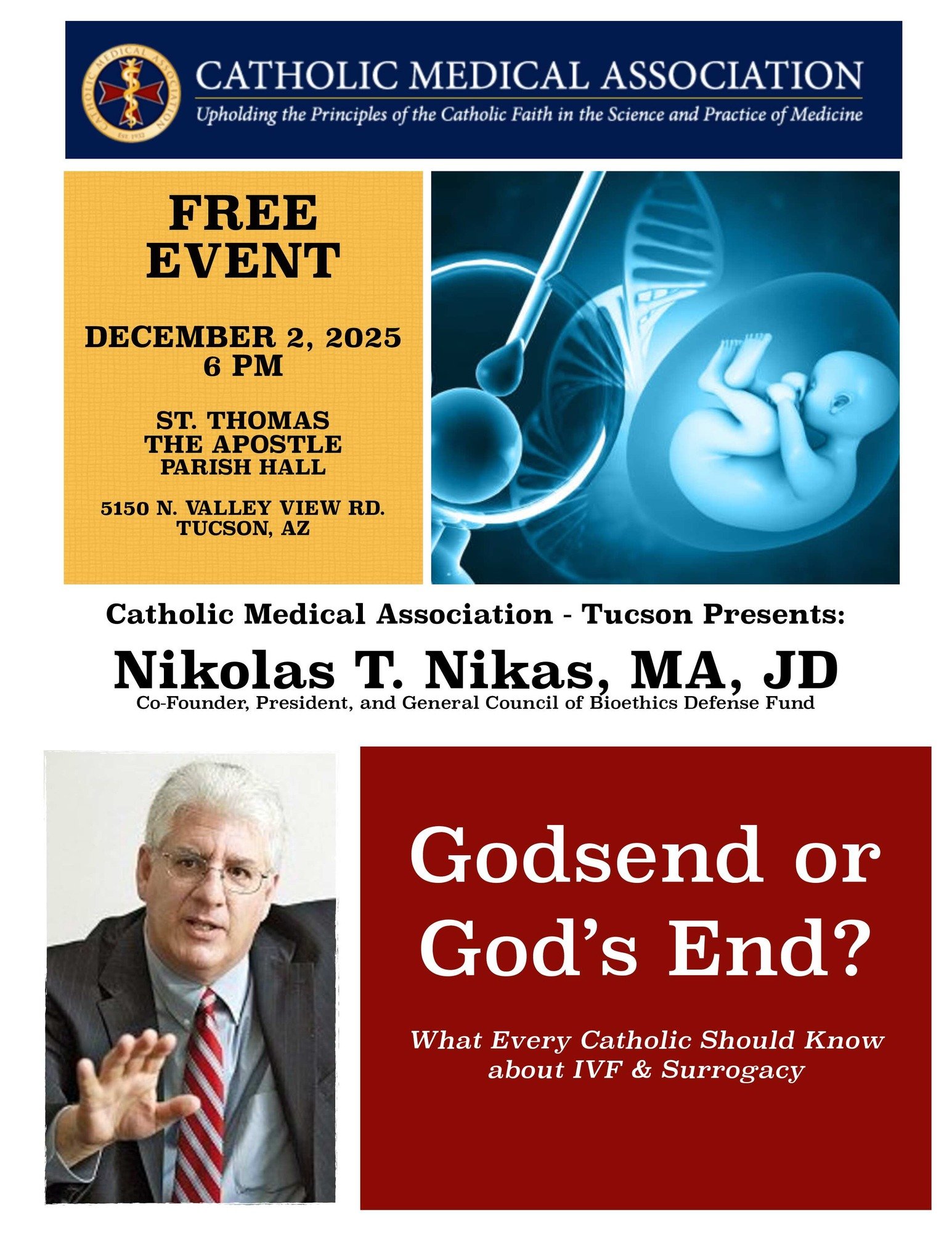
For those married couples who carry the cross of infertility and are tempted to lay it down in the pursuit of IVF, my heart goes out to you. I cannot fathom the pain and the difficulty with which you are burdened. I can, however, offer some consolation and good news that there are many very successful treatment options that the Church supports. Treatment methods such as those of restorative reproductive medicine and fertility awareness, which are aimed at evaluating and treating the root causes of infertility and helping to achieve a natural pregnancy through sexual union. In the words of Bishop James Conley, episcopal advisor to the Catholic Medical Association, “Infertility cannot always be resolved successfully, either by restorative measures or IVF. But restorative options provide great hope and opportunity to couples, while respecting the dignity of human life, marriage, family life, and Church teachings.”. 3If you are interested in learning more about the moral and ethical issues surrounding IVF, including what the Church teaches, the Tucson Guild of the Catholic Medical Association invites you to join us at St. Thomas the Apostle Parish on Tuesday, December 2 at 6pm. Co-founder, president and general counsel of the Bioethics Defense Fund, Nikolas T. Nikas, M.A., J.D., will be presenting his talk: “Godsend or God’s End?: What Every Catholic Should Know about IVF and Surrogacy.”. We hope to see you there.
For more information about restorative reproductive medicine please visit: www.factsaboutfertility.org
For more information about the Catholic Medical Association please visit: www.cathmed.org
Sources:- Pew Research Center. (2013). Abortion Viewed in Moral Terms: Fewer See Stem Cell Research and IVF as Moral Issues. Retrieved from https://www.pewresearch.org/religion/2013/08/15/abortion-viewed-in-moral-terms/
- Pew Research Center. (2025). Most U.S. Catholics Say They Want the Church To Be ‘More Inclusive’. Retrieved from https://www.pewresearch.org/religion/2025/04/30/most-us-catholics-say-they-want-the-church-to-be-more-inclusive/
If you are interested in learning more about the Church's position on IVF please join us Tuesday, December 2 at St. Thomas the Apostle parish hall.